The Radiant Ventilated Cool Roof Sub-Assembly
The Proven Benefits of Stone Coated Steel Roofing and the Energy Saving Benefits of 'Radiant Above Sheathing Ventilation'

Cool Roof Shake
The Beauty & Durability of a Stone Coated Steel Roof, PLUS the Energy Saving Efficiency of the Cool Roof Batten™
COOL ROOF CANADA roof panels are made from stone coated steel backed by a 50 YEAR WARRANTY. They are designed to work with our patent pending Cool Roof Batten™ which harnesses 3 proven technologies known to create thermal resistance and reduce heat conduction within steep slope roof deck assemblies;
1- Above Sheathing Ventilation (ASV) - using metal battens and counter battens to create an optimized convection and drainage plane between between the roof sheathing and roof substrate.
2- Radiant Barriers installed within the ASV assembly that prevent 97% of radiant energy from entering the attic space.
3- Sheathing Vents installed in the sub tile ventilation cavity that draw heated air out of the attic into the above sheathing ventilation system and dramatically improve roof ventilation .
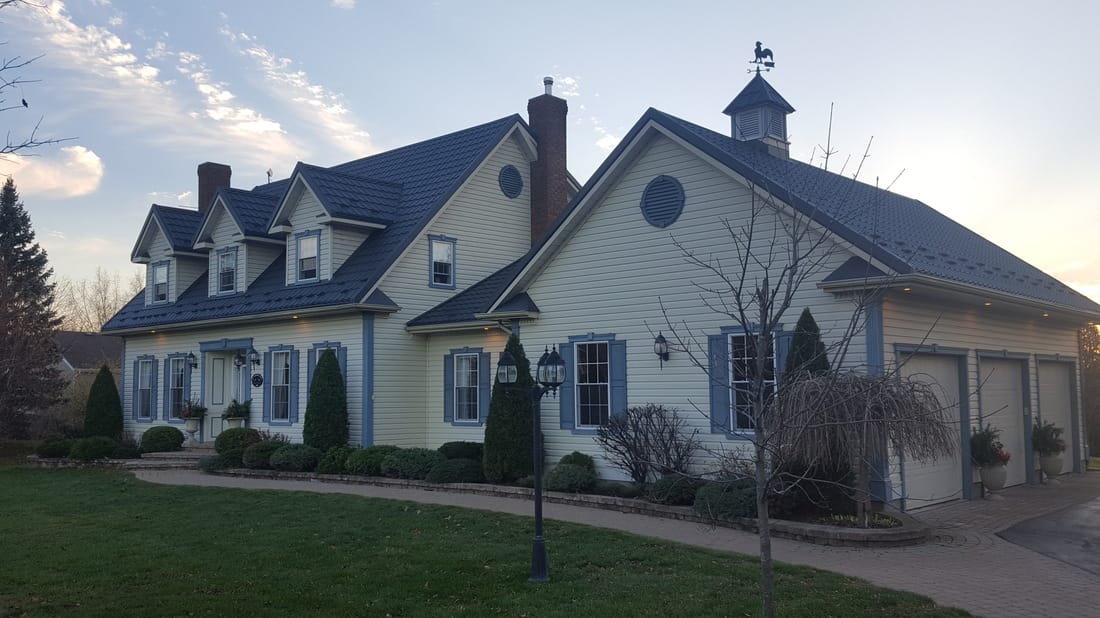
Radiant Ventilated Cool Roofs Come in 3 Styles and over half a dozen colours;
A Radiant Cool Roof Can Save up to 25% in Summer Cooling Costs and 5%-10% in Winter Heating Costs
Installing a metal roof with 'Radiant Above Sheathing Ventilation' ('RASV') can save you up to 25% in Summer Cooling Costs and 5%-10% in Winter Heating costs compared to a regular asphalt shingle roof.
Cool Roof Compliance: A Radiant ASV Cool Roof complies with Title 24 California Building Standards, Section 152, and NAHB Green Building Standard, Chapter 7, which both state that roofs installed with an appropriate air gap are considered equivalent to the prescriptive definition of a cool roof (i.e cool pigment roofs)- regardless of the roof color and it's associated solar reflectance.
Attic Ventilation Controls Moisture and Cooling Costs
Attic ventilation is important to control moisture and keep cooling costs down. Heat can build up in the attic during summer months, and increase costs to cool your home. When it is in the 90s outside, the temperature in your attic can top 150 degrees. Excess moisture in a home can rise into the attic, collect and damage insulation and the home itself if a roof is not adequately vented. Mold spores grow in wet areas, causing indoor air quality problems. Correctly ventilating, insulating and sealing the attic will keep your attic dry and reduce energy bills. Air conditioning can account for 30% to 40% of the total utility bill during the summer.
COOL ROOF CANADA roof panels are made from stone coated steel backed by a 50 YEAR WARRANTY. They are designed to work with our patent pending Cool Roof Batten™ which harnesses 3 proven technologies known to create thermal resistance and reduce heat conduction within steep slope roof deck assemblies;
1- Above Sheathing Ventilation (ASV) - using metal battens and counter battens to create an optimized convection and drainage plane between between the roof sheathing and roof substrate.
2- Radiant Barriers installed within the ASV assembly that prevent 97% of radiant energy from entering the attic space.
3- Sheathing Vents installed in the sub tile ventilation cavity that draw heated air out of the attic into the above sheathing ventilation system and dramatically improve roof ventilation .
Radiant Ventilated Cool Roofs Come in 3 Styles and over half a dozen colours;
A Radiant Cool Roof Can Save up to 25% in Summer Cooling Costs and 5%-10% in Winter Heating Costs
Installing a metal roof with 'Radiant Above Sheathing Ventilation' ('RASV') can save you up to 25% in Summer Cooling Costs and 5%-10% in Winter Heating costs compared to a regular asphalt shingle roof.
Cool Roof Compliance: A Radiant ASV Cool Roof complies with Title 24 California Building Standards, Section 152, and NAHB Green Building Standard, Chapter 7, which both state that roofs installed with an appropriate air gap are considered equivalent to the prescriptive definition of a cool roof (i.e cool pigment roofs)- regardless of the roof color and it's associated solar reflectance.
Attic Ventilation Controls Moisture and Cooling Costs
Attic ventilation is important to control moisture and keep cooling costs down. Heat can build up in the attic during summer months, and increase costs to cool your home. When it is in the 90s outside, the temperature in your attic can top 150 degrees. Excess moisture in a home can rise into the attic, collect and damage insulation and the home itself if a roof is not adequately vented. Mold spores grow in wet areas, causing indoor air quality problems. Correctly ventilating, insulating and sealing the attic will keep your attic dry and reduce energy bills. Air conditioning can account for 30% to 40% of the total utility bill during the summer.
About 'Radiant Above Sheathing Ventilation'
'Radiant Above Sheathing Ventilation' - How it Works
Solar radiation absorbed by the metal roof panels is dissipated in the radiant sheathing ventilation channel and buoyant heated air is channeled by convection from the soffit to the ridge, where it is vented back in to the atmosphere via a concealed ridge vent.
'Radiant Above Sheathing Ventilation' Reduces Summer heat flow in to Attics by up to 45%
In Summer Radiant Above Sheathing Ventilation (or RASV) reduces heat flowing in to attics by up to 45%, saving 25% in Summer Cooling Costs.
- Vertical Metal Riser Battens are first installed over sheathing between the soffit and the ridge.
- Next, Horizontal Metal Battens are applied on top of the Vertical Metal Riser Battens (to which stone coated steel roof panels or roof tiles are applied)
- This forms an air gap referred to as 'Above Sheathing Ventilation' (or ASV) between the roof sheathing and the roof panels.
- The lower surface of this ventilation channel is covered in a radiant foil vapor barrier that deflects 97% of radiant energy from entering the roof attic.
- The upper surface of the ventilation channel is formed by the unpainted galvalume metal underside of the stone coated steel roofing panels.
Solar radiation absorbed by the metal roof panels is dissipated in the radiant sheathing ventilation channel and buoyant heated air is channeled by convection from the soffit to the ridge, where it is vented back in to the atmosphere via a concealed ridge vent.
'Radiant Above Sheathing Ventilation' Reduces Summer heat flow in to Attics by up to 45%
In Summer Radiant Above Sheathing Ventilation (or RASV) reduces heat flowing in to attics by up to 45%, saving 25% in Summer Cooling Costs.
'Radiant Above Sheathing Ventilation' (RASV) Reduces Winter Heat Loss from Attics
In Winter, Radiant Above Sheathing Ventilation serves as an insulating layer to reduce radiant and convective heat transfer between the roof deck and the underside of the metal roof panels. According to the ORNL, 'the winter heat loss from attics through radiative cooling of roof decks with ASV ventilation is 50% less than the heat lost from standard asphalt shingle roofs'. This can add potential savings of 5%-10% in winter heating costs.
The picture on the left illustrates how early morning condensation (in the form of frozen frost) appears much denser directly above trusses and rafters. This is caused by heat escaping from the attic and the sheathing by means of radiative cooling of asphalt shingles. It also reveals the innefficiencies of traditional roof ventilation with R40 Insulation.
'Radiant Above Sheathing Ventilation' (RASV) prevents Ice Damming
Why 'Radiant Above Sheathing Ventilation' prevents Ice Damming in Winter
- Winter heat loss from attics causes snow and ice to melt and trickle down towards the eave of the roof.
- When the melted snow trickles over the cooler eaves of the roof it refreezes whenever the ambient temperature is below freezing.
- This results in Ice Damming which can cause roof leaks and roof damage.
- RASV roofs have a radiant air gap that serves as an insulating air layer to prevent snow from melting until the ambient temperature is above zero, thereby preventing Ice Damming.